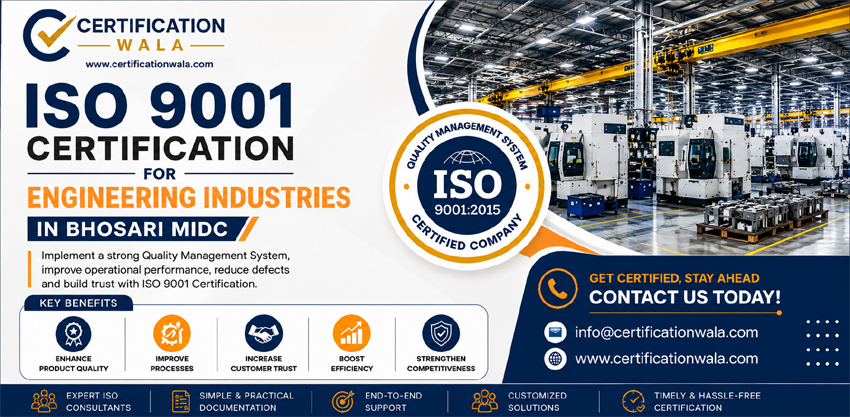
ISO 9001 Certification for Engineering Industries in Bhosari MIDC
Introduction
Engineering companies in Bhosari MIDC operate in a highly competitive industrial environment. From precision machining and fabrication to industrial components, tooling, automotive parts and engineering services, customers expect consistent quality, reliable delivery and proper process control.
This is where ISO 9001 Certification for Engineering Industries in Bhosari MIDC becomes valuable. ISO 9001 provides a structured Quality Management System (QMS) that helps engineering organizations control their processes, understand customer requirements, manage risks, reduce errors and improve continuously.
For an engineering business, ISO 9001 is not simply a certificate to display on a website or office wall. When properly implemented, it can help bring consistency to activities such as quotation review, engineering design, procurement, production planning, inspection, testing, dispatch and customer complaint handling.
ISO explains that ISO 9001 establishes requirements for a quality management system and supports consistent processes, customer satisfaction, performance evaluation and continual improvement.
For companies supplying automobile manufacturers, OEMs, contractors or large industrial buyers around Pune, a well-managed QMS can also strengthen supplier credibility.
Why ISO 9001 Matters for Engineering Industries in Bhosari MIDC
Engineering businesses often deal with drawings, specifications, tolerances, raw materials, inspection requirements, production schedules and customer-specific requirements. A small process failure can result in rejection, rework, delayed delivery or customer complaints.
ISO 9001 helps businesses create defined and repeatable processes.
For example, an engineering component manufacturer may receive a customer drawing and immediately send it to production. Without proper controls, an outdated drawing could be used. Under a structured QMS, document control, order review and production controls help reduce the possibility of such mistakes.
The standard is applicable to organizations of different sizes and sectors, including manufacturing and engineering-related businesses.
Engineering activities that can benefit
ISO 9001 can be useful for:
-
CNC machining companies
-
Fabrication and welding units
-
Tool and die manufacturers
-
Industrial component manufacturers
-
Automotive component suppliers
-
Mechanical engineering companies
-
Electrical engineering businesses
-
Machine manufacturers
-
Precision engineering units
-
Industrial equipment suppliers
-
Engineering design and consultancy firms
-
MSMEs supplying OEMs and large industries
Key Benefits of ISO 9001 Certification
1. Better Process Control
Engineering operations involve multiple interconnected activities. ISO 9001 encourages organizations to identify, define and monitor these processes so that responsibilities are clear and work is performed consistently.
2. Reduction in Defects and Rework
Quality problems can increase material consumption, labour costs and delivery delays. Proper inspection, process monitoring, corrective action and documented procedures can help engineering companies identify recurring problems and prevent them from happening again.
3. Improved Customer Confidence
Customers want suppliers who can consistently meet specifications and delivery commitments. ISO 9001 certification provides independent evidence that an organization has established a formal quality management system.
4. Stronger OEM and Supplier Opportunities
Many large organizations consider quality certifications during supplier evaluation and vendor development. ISO 9001 may therefore strengthen the credibility of a Bhosari-based engineering company when approaching new customers.
Certification itself does not guarantee a contract, but a properly implemented QMS can make a company better prepared for customer audits and supplier assessments.
5. Improved Documentation and Traceability
Engineering companies often need to maintain records related to inspections, material purchases, production, calibration, customer requirements and corrective actions. A controlled documentation system makes these records easier to manage and retrieve.
6. Continuous Improvement
ISO 9001 encourages organizations to measure performance, identify problems and take corrective action. Over time, this can help management make decisions based on actual process performance rather than assumptions.
ISO also highlights improved efficiency, customer confidence, process improvement and continual optimization as important benefits of ISO 9001.
Why Choose Certification Wala?
Choosing the right consultant can make the ISO certification journey easier for an engineering company. Certification Wala provides ISO certification support for businesses across Pune, including Bhosari MIDC, Pimpri-Chinchwad, Chakan MIDC, Talegaon and other industrial areas. Its existing Pune service page specifically lists Bhosari MIDC and ISO 9001 among its service locations and offerings.
Our approach focuses on understanding the actual business instead of creating unnecessary paperwork.
Our support includes:
-
Initial business assessment
-
ISO 9001 requirement guidance
-
Gap analysis
-
QMS documentation support
-
Process implementation guidance
-
Internal audit preparation
-
Corrective action guidance
-
Certification audit preparation
-
Coordination and certification support
-
Post-certification guidance
For engineering MSMEs, this practical approach helps connect ISO requirements with everyday activities such as production planning, inspection, purchasing, maintenance and customer communication.
Step-by-Step ISO 9001 Certification Process
Step 1: Initial Consultation
The first step is understanding the company's activities, workforce, locations, products or services and certification scope.
Step 2: Gap Analysis
Existing systems are reviewed against ISO 9001 requirements. This helps identify gaps in documentation, process controls, monitoring, records and responsibilities.
Step 3: Documentation Preparation
Relevant QMS documentation is prepared based on the organization's actual operations. This may include policies, procedures, process documents, formats and records.
Step 4: Implementation
The documented system is put into practice. Employees are made aware of their responsibilities, and required records begin to be maintained.
Step 5: Internal Audit
An internal audit helps identify nonconformities and areas requiring improvement before the external certification audit.
Step 6: Management Review and Corrective Action
Management evaluates QMS performance, audit findings, customer feedback, objectives and improvement opportunities. Identified issues are addressed appropriately.
Step 7: Certification Audit
An independent certification body evaluates the organization's management system against the applicable ISO 9001 requirements. ISO itself does not issue certificates; certification is performed by independent certification bodies.
Step 8: Certification
After successful completion of the certification process and closure of applicable findings, the organization can receive its ISO 9001 certificate.
Documents Required for ISO 9001 Certification
The exact documentation depends on the company's size, activities and QMS scope. Common information and records may include:
-
Company registration documents
-
GST registration details
-
PAN details
-
Business address proof
-
Organization structure
-
Scope of certification
-
Quality policy
-
Quality objectives
-
Process details
-
Customer requirement records
-
Purchase and supplier records
-
Production records
-
Inspection and testing records
-
Calibration records, where applicable
-
Training records
-
Internal audit records
-
Management review records
-
Corrective action records
-
Customer feedback or complaint records
The purpose is not to create paperwork for its own sake. Documentation should support effective control of the company's real processes.
Internal Linking Suggestions
For stronger topical relevance and user navigation, consider linking this article to:
-
ISO 14001 Certification in Pune
-
ISO 45001 Certification in Pune
-
ISO 27001 Certification in Pune
-
ISO Certification in Bhosari MIDC
Certification Wala's current Pune page also maintains dedicated location/service links for Bhosari MIDC and ISO 9001 Certification in Pune.
External Authority Reference
For an authoritative explanation of ISO 9001 requirements, benefits and certification, reference the official International Organization for Standardization (ISO) website. ISO's current resources explain the role of quality management systems, customer focus, process control, performance evaluation and continual improvement.
Important update: ISO has published information for the ISO 9001:2026 edition. Organizations planning certification or transition should confirm the applicable edition and transition requirements with their certification body before implementation.
Frequently Asked Questions
1. What is ISO 9001 Certification for Engineering Industries in Bhosari MIDC?
ISO 9001 Certification for Engineering Industries in Bhosari MIDC confirms that an engineering organization has established and operates a quality management system that meets the applicable ISO 9001 requirements. It can help improve process consistency, customer satisfaction and continual improvement.
2. Why should an engineering company in Bhosari MIDC obtain ISO 9001 certification?
Engineering companies can use ISO 9001 to standardize processes, reduce quality problems, improve documentation, strengthen customer confidence and become better prepared for supplier evaluations and business opportunities.
3. What documents are required for ISO 9001 certification?
Typical documents and records include company details, certification scope, quality policy, objectives, process information, supplier records, production and inspection records, training records, internal audit reports, management review records and corrective action records. Requirements vary according to the organization.
4. How long does ISO 9001 certification take?
The timeline depends on the organization's size, scope, existing QMS, documentation and readiness for audit. A company with established processes may require less preparation than an organization starting its QMS from the beginning.
5. Is ISO 9001 mandatory for engineering companies in India?
ISO 9001 certification is generally voluntary. However, individual customers, tenders, supply chains or contractual arrangements may specify certification requirements. Businesses should check the requirements applicable to their particular customers and contracts.
Conclusion
ISO 9001 Certification for Engineering Industries in Bhosari MIDC can be a practical business improvement tool when the QMS is designed around actual engineering operations.
From production control and inspection to supplier management, customer requirements and corrective action, ISO 9001 helps organizations create a more structured approach to quality. For Bhosari MIDC engineering companies competing for OEM, industrial and export opportunities, this can strengthen credibility while supporting more consistent operations.
Certification Wala can assist with the complete journey, including ISO 9001 requirement understanding, gap assessment, documentation, implementation guidance, internal audit preparation and certification support.
Ready to improve your engineering company's quality system?
Contact Certification Wala for a professional consultation:
Email: info@certificationwala.com
Website: www.certificationwala.com
Phone: +91 97119 97756
Get in touch today to discuss your business scope and find the right approach for ISO 9001 Certification for Engineering Industries in Bhosari MIDC.