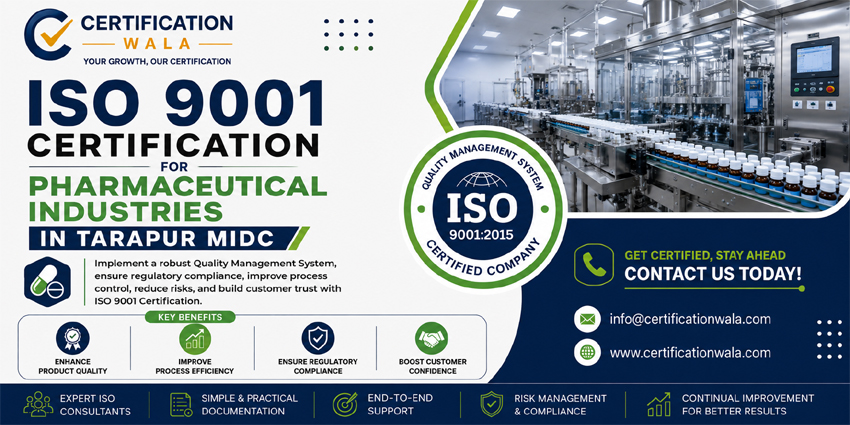
ISO 9001 Certification for Pharmaceutical Industries in Tarapur MIDC
Introduction
Tarapur MIDC is an important industrial hub in Maharashtra with pharmaceutical, chemical, engineering and other manufacturing businesses. Pharmaceutical companies operating in this environment work in a highly quality-focused sector where consistency, traceability, documentation and controlled processes are essential.
For a pharmaceutical manufacturer, quality cannot depend only on final-product inspection. It must be built into the way raw materials are received, processes are performed, equipment is controlled, employees are trained and records are maintained.
This is where ISO 9001 Certification for Pharmaceutical Industries in Tarapur MIDC can provide a structured framework for managing quality.
ISO 9001 is a globally recognized Quality Management System (QMS) standard. It helps organizations establish, maintain and continually improve processes for consistently meeting customer and applicable requirements. ISO states that the standard can be used by organizations of different sizes and sectors.
For a pharmaceutical organization, ISO 9001 can support processes such as supplier evaluation, purchasing, production planning, document control, training, monitoring, customer feedback, complaint handling, corrective action and management review.
However, pharmaceutical manufacturers should understand an important distinction: ISO 9001 does not replace pharmaceutical regulatory or Good Manufacturing Practice (GMP) requirements. India's pharmaceutical manufacturing framework includes specific regulatory requirements, including Schedule M GMP provisions. The Central Drugs Standard Control Organization (CDSCO) publishes relevant pharmaceutical manufacturing and WHO-GMP information.
Why Choose ISO 9001 Certification for Pharmaceutical Industries in Tarapur MIDC?
Pharmaceutical businesses operate through interconnected processes. A weakness in supplier management, documentation, production control, testing or complaint handling can affect the overall quality system.
For example, imagine a pharmaceutical manufacturer receiving an active ingredient from an approved supplier. If purchasing, incoming inspection, material identification and record controls are not properly coordinated, the organization may face avoidable quality and traceability problems.
ISO 9001 encourages organizations to identify their processes, assign responsibilities, monitor performance and continually improve the QMS.
ISO 9001 can be relevant for:
-
Pharmaceutical manufacturers
-
Formulation manufacturers
-
API-related organizations
-
Pharmaceutical packaging companies
-
Contract manufacturing organizations
-
Pharmaceutical raw-material suppliers
-
Medical and laboratory product businesses
-
Pharma distribution and support organizations
-
Quality testing and related service providers
The exact certification scope should reflect the company's actual activities.
Key Benefits of ISO 9001 Certification
1. Stronger Quality Management
ISO 9001 helps organizations establish a structured approach to quality rather than relying only on individual employees or final inspection.
It supports defined responsibilities, process controls, monitoring and continual improvement.
2. Better Process Consistency
Pharmaceutical manufacturing involves multiple controlled activities. A process-based QMS helps ensure that important operations are performed consistently and monitored appropriately.
3. Improved Documentation and Traceability
Documentation is particularly important in pharmaceutical operations. Controlled records can help organizations demonstrate what was done, when it was done and who was responsible.
ISO 9001 specifically addresses documented information, operational control, performance evaluation and improvement.
4. Better Supplier Management
The quality of purchased materials can directly affect manufacturing outcomes.
A systematic supplier evaluation and monitoring process helps organizations make informed decisions about external providers and maintain appropriate controls.
5. Effective Complaint and Corrective Action Management
Customer complaints can provide valuable information about product or service performance.
ISO 9001 supports systematic evaluation of nonconformities and corrective actions so organizations can address underlying causes instead of repeatedly dealing with the same issue.
6. Improved Customer Confidence
Certification to ISO 9001 can demonstrate an organization's commitment to maintaining a recognized quality management system. ISO notes that certification can provide stakeholders with confidence when issued by an appropriate conformity assessment body.
7. Continual Improvement
Pharmaceutical businesses need to monitor their processes and respond to changing customer, operational and regulatory expectations.
ISO 9001 encourages performance evaluation and continual improvement, helping management use data and audit findings to identify opportunities for improvement.
Why Choose Certification Wala?
For pharmaceutical businesses, ISO implementation should be practical and aligned with the organization's existing quality and operational systems.
Certification Wala provides ISO certification support for businesses in Maharashtra and assists organizations with understanding requirements, conducting gap assessments, preparing QMS documentation and preparing for certification audits.
Our support includes:
-
Initial consultation
-
Business and process assessment
-
Certification scope guidance
-
Gap analysis
-
QMS documentation support
-
Process implementation guidance
-
Quality objective guidance
-
Internal audit preparation
-
Corrective action support
-
Management review preparation
-
Certification audit preparation
-
Certification process coordination
Our approach is to understand the organization's actual processes before recommending documentation or implementation activities.
Step-by-Step ISO 9001 Certification Process
Step 1: Understand the Organization
The first stage is to review the company's products, manufacturing activities, departments, locations, customers and existing quality practices.
For a pharmaceutical organization, the assessment should also consider the relationship between the QMS and applicable regulatory requirements.
Step 2: Define the Certification Scope
The organization determines which products, services, locations and activities will be covered by the ISO 9001 QMS.
The scope should be accurate and should not make claims beyond the organization's actual operations.
Step 3: Conduct a Gap Analysis
Existing processes are compared against the applicable ISO 9001 requirements.
The review may cover:
-
Customer requirements
-
Supplier controls
-
Document control
-
Production processes
-
Quality monitoring
-
Employee competency
-
Equipment and infrastructure
-
Customer complaints
-
Internal audits
-
Corrective actions
-
Management review
Step 4: Prepare QMS Documentation
Relevant policies, procedures, process controls, forms and records are developed according to the organization's actual operations.
The purpose is to create useful documentation that supports consistent work—not paperwork created only for an audit.
Step 5: Implement the QMS
The organization puts the defined processes into practice. Employees understand their responsibilities, records are maintained and quality objectives are monitored.
Step 6: Conduct an Internal Audit
An internal audit evaluates whether the QMS is implemented effectively and identifies nonconformities or opportunities for improvement.
Step 7: Management Review
Management reviews information such as customer feedback, audit findings, quality objectives, process performance, corrective actions and improvement opportunities.
Step 8: Certification Audit
An independent certification body evaluates the organization's QMS against the applicable ISO 9001 requirements.
ISO itself does not issue ISO 9001 certificates. Certification is performed by independent certification bodies.
Step 9: Certification
After successful completion of the applicable audit process and closure of required findings, the organization can receive its ISO 9001 certificate from the certification body.
Documents Required for ISO 9001 Certification
The exact documentation depends on the organization's certification scope, size, processes and existing management system.
Common information and records may include:
-
Company registration details
-
PAN and GST information
-
Business address
-
Organization structure
-
QMS certification scope
-
Quality policy
-
Quality objectives
-
Process flow information
-
Customer requirement records
-
Supplier evaluation records
-
Purchase records
-
Incoming material records
-
Production records
-
Inspection and testing records
-
Equipment maintenance records
-
Calibration records, where applicable
-
Training and competency records
-
Customer feedback records
-
Complaint records
-
Internal audit records
-
Management review records
-
Corrective action records
-
Monitoring and measurement records
Pharmaceutical manufacturers should also maintain the records required by applicable pharmaceutical laws, licenses, GMP requirements and customer or regulatory obligations. ISO 9001 should be treated as part of the broader management framework, not as a substitute for regulatory compliance.
ISO 9001 and Pharmaceutical GMP: An Important Difference
A common question is whether ISO 9001 certification is the same as pharmaceutical GMP certification.
It is not.
ISO 9001 is a general Quality Management System standard applicable across sectors. GMP requirements are specifically concerned with pharmaceutical manufacturing controls and regulatory expectations.
India's CDSCO publishes information relating to WHO-GMP-certified manufacturing units, while Schedule M sets out GMP provisions for pharmaceutical manufacturing.
Therefore, a pharmaceutical company should determine which standards, licenses, GMP requirements and customer-specific expectations apply to its operations before deciding its certification strategy.
ISO 9001 can complement a company's broader quality framework, but it should not be represented as proof of pharmaceutical regulatory compliance by itself.
Internal Linking Suggestions
For stronger topical authority and user navigation, naturally link this article to relevant Certification Wala pages:
-
ISO Certification in Pune: https://certificationwala.com/iso-certification-in-pune
-
ISO 9001 Certification in Pune: https://certificationwala.com/iso-9001-certification-in-pune
-
ISO 14001 Certification
-
ISO 45001 Certification
-
ISO 22000 Certification
-
ISO 27001 Certification
-
ISO Certification in Maharashtra
If Certification Wala has a dedicated pharmaceutical or Tarapur service page, it should also be linked naturally from this article.
External Authority Reference
For ISO 9001 requirements, benefits and certification information, the official International Organization for Standardization (ISO) website is the preferred authority. ISO confirms that ISO 9001 applies across sectors and addresses areas including leadership, planning, support, operation, performance evaluation and improvement.
For Indian pharmaceutical regulatory information, the Central Drugs Standard Control Organization (CDSCO) should be referenced for applicable regulatory and GMP information.
Frequently Asked Questions
1. What is ISO 9001 Certification for Pharmaceutical Industries in Tarapur MIDC?
ISO 9001 Certification for Pharmaceutical Industries in Tarapur MIDC demonstrates that a pharmaceutical organization has implemented a Quality Management System that meets applicable ISO 9001 requirements.
2. Why should a pharmaceutical company in Tarapur MIDC get ISO 9001 certification?
ISO 9001 can help pharmaceutical businesses strengthen process management, supplier controls, documentation, customer feedback, corrective action and continual improvement. It can also support customer confidence in the organization's quality management practices.
3. Is ISO 9001 the same as GMP certification for pharmaceutical companies?
No. ISO 9001 is a general Quality Management System standard, while GMP requirements are specific to pharmaceutical manufacturing and regulatory controls. A pharmaceutical company may need to comply with applicable GMP and other regulatory requirements in addition to ISO 9001.
4. What documents are required for ISO 9001 certification in Tarapur MIDC?
Typical QMS documentation may include company details, certification scope, quality policy, quality objectives, process information, supplier records, production records, inspection records, training records, internal audit records, management review records and corrective-action records. Additional pharmaceutical regulatory records may also apply.
5. How long does ISO 9001 certification take for a pharmaceutical company?
The timeline depends on the organization's size, certification scope, existing QMS, process maturity and audit readiness. Pharmaceutical companies may also need to coordinate ISO implementation with their existing quality and regulatory systems.
Conclusion
ISO 9001 Certification for Pharmaceutical Industries in Tarapur MIDC can help pharmaceutical organizations create a more structured, measurable and customer-focused Quality Management System.
From supplier management and document control to production support, employee competency, customer complaints, corrective action and continual improvement, ISO 9001 provides a framework for managing quality across the organization.
For pharmaceutical businesses, however, ISO 9001 should be considered alongside applicable GMP, licensing and regulatory requirements. It is a quality management certification—not a replacement for pharmaceutical regulatory compliance.
Certification Wala can support your organization with ISO 9001 gap assessment, QMS documentation, implementation guidance, internal audit preparation and certification audit support.
Ready to discuss ISO 9001 Certification for your pharmaceutical business in Tarapur MIDC?
Contact Certification Wala for professional guidance:
Email: info@certificationwala.com
Website: www.certificationwala.com
Share your business scope and current quality-system requirements with the Certification Wala team to plan a practical route toward ISO 9001 certification.