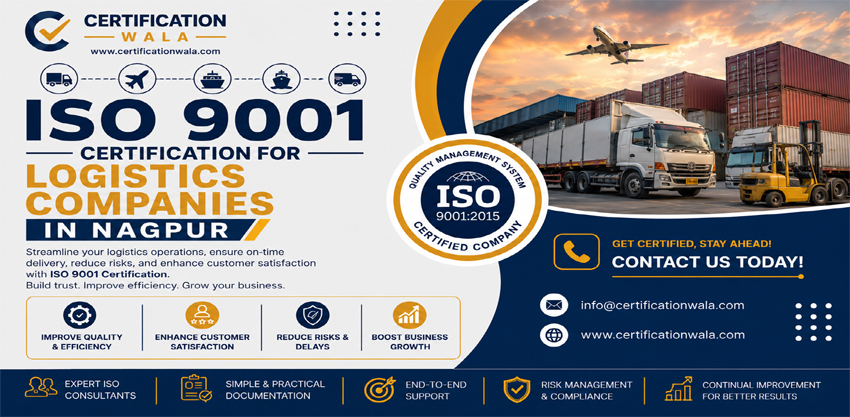
ISO Certification for Logistics Companies in Nagpur
Introduction
Nagpur has an important position in India's logistics network because of its central location and strong road, rail, warehousing and distribution connectivity. Logistics companies in the city support manufacturers, retailers, e-commerce businesses, exporters, distributors and other organizations that depend on timely and reliable movement of goods.
For a logistics company, however, delivering a shipment from one location to another is only one part of the service. Customers also expect proper documentation, shipment tracking, vehicle controls, trained employees, supplier management, complaint handling and consistent service quality.
This is where ISO Certification for Logistics Companies in Nagpur can provide a structured advantage.
ISO certification helps logistics organizations establish documented processes, monitor performance, identify risks and create a systematic approach to continual improvement. The most suitable standard depends on the organization's services and objectives.
Common ISO standards relevant to logistics and transportation businesses include:
- ISO 9001 – Quality Management System
- ISO 14001 – Environmental Management System
- ISO 45001 – Occupational Health and Safety Management System
- ISO 39001 – Road Traffic Safety Management System
- ISO 22301 – Business Continuity Management System
- ISO 27001 – Information Security Management System
For example, a freight forwarding company may focus on ISO 9001, while a road transport operator may also consider ISO 39001. A logistics company managing large warehouses may benefit from ISO 45001 and ISO 14001 depending on its activities.
Why ISO Certification Matters for Logistics Companies
Logistics operations involve multiple moving parts. A single shipment may pass through drivers, warehouses, transport coordinators, third-party vendors and customer service teams.
Without clear processes, even a small communication gap can result in delayed deliveries, incorrect documentation, damaged goods or customer complaints.
ISO certification encourages logistics companies to define responsibilities and establish consistent methods for managing these activities.
For instance, a Nagpur-based transport company handling industrial shipments may use documented vehicle inspection, driver competency, route planning, delivery confirmation and complaint-handling processes to improve service reliability.
An ISO management system does not guarantee that every shipment will be perfect. Instead, it provides a structured framework for identifying problems, controlling risks and improving processes.
Why Choose Certification Wala?
ISO certification is more effective when the management system reflects your actual logistics operations.
Certification Wala provides ISO certification assistance that can include standard selection, gap assessment, documentation support, implementation guidance and certification audit preparation. The company states that it has more than 10 years of experience and has completed more than 4,000 certifications. (certificationwala.com)
Our approach includes:
- Understanding your logistics and transportation activities
- Selecting the appropriate ISO standard
- Defining the certification scope
- Reviewing existing operational processes
- Conducting a gap assessment
- Supporting required documentation
- Guiding employees on relevant procedures
- Preparing the company for internal audit activities
- Supporting certification audit preparation
- Helping address identified nonconformities
The focus should be on building a useful management system, not simply preparing documents for an audit.
Key Benefits of ISO Certification for Logistics Companies in Nagpur
1. Improved Service Consistency
ISO 9001 can help logistics businesses establish consistent processes for order handling, transportation, delivery and customer communication.
2. Greater Customer Confidence
Corporate customers often prefer logistics partners that can demonstrate structured processes and a commitment to quality.
ISO certification can strengthen your company's professional profile during vendor evaluations.
3. Better Risk Management
Logistics operations face risks involving transportation, weather, vehicle breakdowns, documentation, suppliers, delivery delays and workplace safety.
A structured management system helps identify and address relevant risks systematically.
4. Improved Operational Efficiency
Clear procedures can reduce avoidable duplication, communication errors and inconsistent working methods.
This can be particularly useful as a logistics company grows and manages more vehicles, employees, routes or customers.
5. Stronger Road Safety Practices
For transportation companies, ISO 39001 provides a framework focused on road traffic safety management. It can be relevant to organizations whose activities have an impact on road traffic safety.
6. Better Workplace Safety
Warehouse employees, drivers, loading teams and maintenance workers may face different occupational hazards.
ISO 45001 can help organizations establish a systematic occupational health and safety management approach.
7. Environmental Responsibility
Transportation and warehousing can involve fuel consumption, emissions, packaging waste and energy use.
ISO 14001 provides a framework for organizations to manage environmental aspects and continually improve environmental performance.
8. Stronger Business Opportunities
ISO certification can improve credibility when approaching large manufacturers, corporate buyers, exporters and other organizations that evaluate suppliers based on documented management practices.
Which ISO Certification Is Suitable for a Logistics Company?
ISO 9001 Certification
ISO 9001 is widely applicable to logistics businesses that want to improve quality management and service consistency.
It can cover activities such as:
- Transportation services
- Freight forwarding
- Warehousing
- Distribution
- Courier operations
- Supply chain support
- Logistics coordination
ISO 14001 Certification
Companies seeking a structured environmental management system may consider ISO 14001.
It can help organizations identify relevant environmental aspects such as fuel consumption, waste, resource use and applicable compliance obligations.
ISO 45001 Certification
This standard is particularly relevant where employees face workplace risks associated with warehouses, loading operations, vehicles, material handling and other logistics activities.
ISO 39001 Certification
ISO 39001 is specifically related to road traffic safety management and may be relevant to transport operators and organizations involved in road-based logistics.
Step-by-Step ISO Certification Process
Step 1: Identify the Applicable Standard
First, determine which ISO standard matches your logistics services and business objectives.
Step 2: Define the Certification Scope
The scope should clearly describe the activities and locations covered by the management system.
For example, the scope could cover transportation and logistics services from a specific operational location.
Step 3: Conduct a Gap Analysis
Existing processes are compared with the requirements of the selected ISO standard.
This helps identify missing procedures, records, controls and improvement areas.
Step 4: Prepare Documentation
Relevant policies, procedures, risk assessments, work instructions and operational records are developed or improved.
Documentation should reflect actual logistics operations.
Step 5: Implement the Management System
Employees are trained on their responsibilities, and the documented processes are put into practice.
Step 6: Conduct Internal Audit
An internal audit helps identify potential nonconformities before the certification audit.
Step 7: Management Review
Management evaluates system performance, objectives, risks, customer feedback, audit findings and opportunities for improvement.
Step 8: Certification Audit
An independent certification body evaluates whether the management system conforms to the applicable ISO requirements.
Step 9: Corrective Actions and Certification
If nonconformities are identified, the organization takes appropriate corrective action. Once applicable requirements are satisfied, certification can be issued.
ISO describes management-system certification as an independent confirmation that a management system meets specified requirements. It also recommends considering the competence and accreditation of certification bodies when selecting certification services. (iso.org)
Documents Required for ISO Certification
The exact documents depend on the selected standard and certification scope. Logistics companies may commonly need:
- Company registration details
- Organization profile
- Business activity information
- Certification scope
- Organizational structure
- Quality, environmental or safety policy
- Process procedures
- Risk and opportunity assessment
- Vehicle inspection records
- Driver competency and training records
- Supplier and transporter evaluation records
- Customer complaint records
- Delivery and service records
- Equipment maintenance records
- Emergency preparedness records, where applicable
- Internal audit records
- Management review records
- Corrective action records
- Applicable legal and regulatory compliance information
For ISO 39001, additional road traffic safety-related processes and evidence may be required. For ISO 45001, occupational hazard identification and safety controls become important parts of the management system.
How Much Does ISO Certification Cost in Nagpur?
There is no universal ISO certification cost for every logistics company.
The final cost may depend on:
- Selected ISO standard
- Number of employees
- Number of locations
- Number and complexity of operations
- Certification scope
- Existing management system
- Audit requirements
- Documentation and implementation support
A small local transport operator and a large logistics company with warehouses and multiple branches will have different certification requirements.
For this reason, businesses should request a customized quotation after discussing their operations and certification objectives.
Frequently Asked Questions
1. What is ISO Certification for Logistics Companies in Nagpur?
ISO Certification for Logistics Companies in Nagpur means that a logistics organization's relevant management system has been assessed against an applicable ISO standard by an independent certification body. ISO 9001 is commonly used for quality management, while ISO 45001, ISO 14001 and ISO 39001 address specific operational areas.
2. Which ISO certification is best for a logistics company?
ISO 9001 is a common choice for logistics businesses seeking better quality and service processes. Transport companies may also consider ISO 39001 for road traffic safety, ISO 45001 for occupational health and safety and ISO 14001 for environmental management.
3. Is ISO 9001 useful for transport and logistics companies?
Yes. ISO 9001 can help transport and logistics organizations establish consistent processes for customer requirements, service delivery, supplier management, monitoring, complaints and continual improvement.
4. What documents are required for ISO certification for a logistics company?
Typical documents include company information, certification scope, policies, procedures, risk assessments, training records, vehicle or equipment records, supplier evaluations, customer records, internal audit reports and management review records. Requirements vary by ISO standard.
5. How long does ISO certification take for a logistics company in Nagpur?
The timeline depends on the company's size, certification scope, selected standard, existing processes and audit requirements. A small logistics organization with established processes may require less preparation than a large company with multiple locations and complex operations.
Get ISO Certification for Your Logistics Company in Nagpur
In logistics, reliability is a business advantage. Customers want their goods delivered safely, on time and with clear communication throughout the process.
A properly implemented ISO management system can help your organization bring greater structure to these activities, identify operational risks and create a culture of continual improvement.
If you are searching for ISO Certification for Logistics Companies in Nagpur, Certification Wala can assist with selecting the appropriate standard, conducting a gap assessment, preparing documentation, supporting implementation and preparing your organization for certification audits.
Contact Certification Wala:
Email: info@certificationwala.com
Website: www.certificationwala.com
Discuss your logistics operations and certification requirements with the Certification Wala team to receive guidance based on your business scope.
Start your ISO certification journey today and build a more consistent, reliable and professionally managed logistics operation.