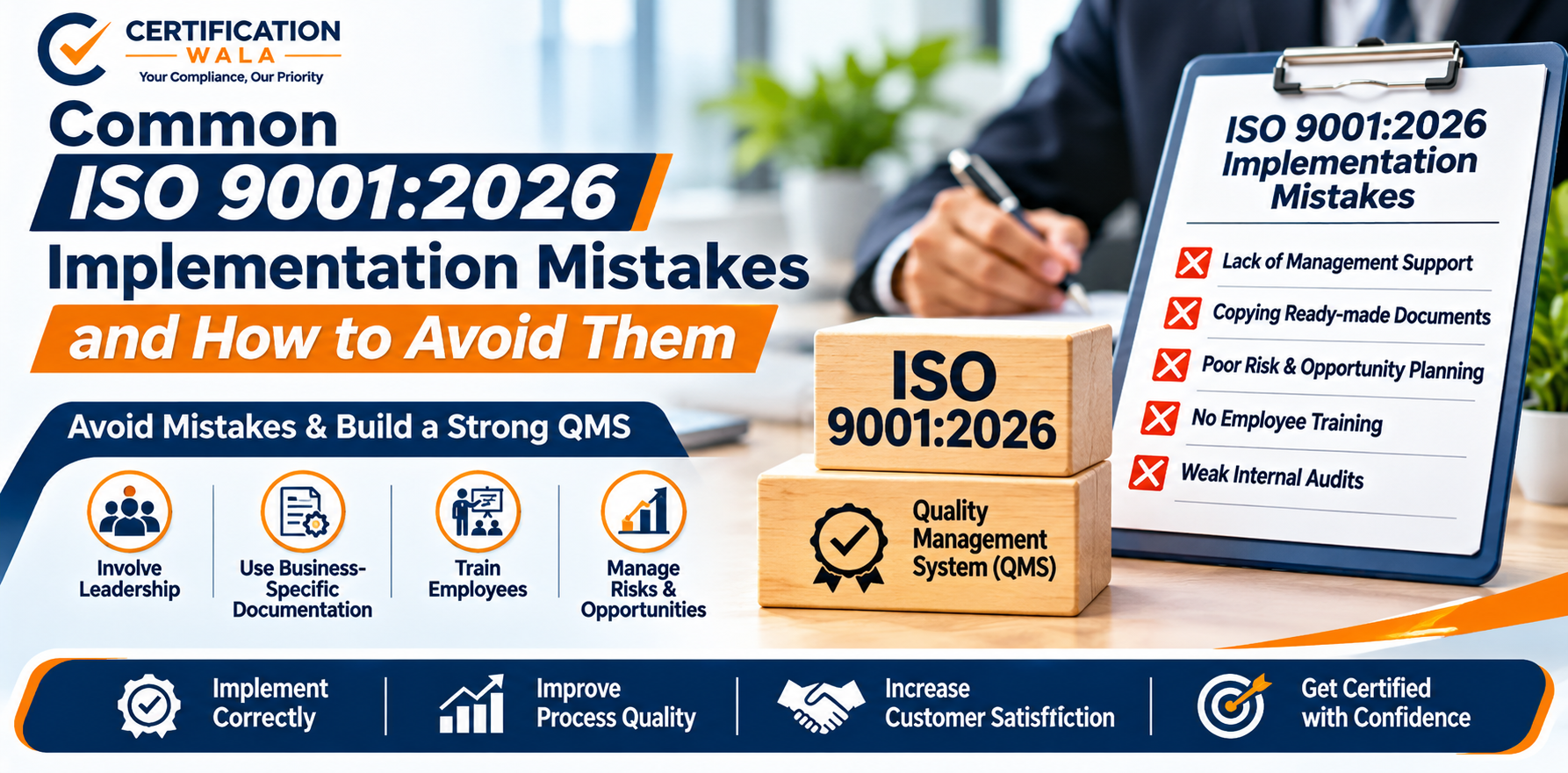
Common ISO 9001 2026 Implementation Mistakes and How to Avoid Them
Introduction
Implementing ISO 9001:2026 is an important step for businesses that want to improve product quality, strengthen customer satisfaction, and establish reliable business processes. For Indian businesses, achieving ISO 9001 certification can also help build customer confidence, improve operational efficiency, and create better opportunities in domestic and international markets.
However, implementing a Quality Management System (QMS) is not simply about preparing documents and obtaining a certificate. Businesses must understand the standard's requirements and apply them to their actual operations.
Many organisations make avoidable mistakes during ISO 9001:2026 implementation. These include copying documentation from other companies, ignoring employee training, overlooking risk management, and treating internal audits as a formality.
For example, a manufacturing company in Delhi may prepare quality procedures but fail to monitor product defects regularly. Similarly, a service company in Mumbai may maintain customer complaint records without analysing recurring problems.
Such gaps can affect audit performance and reduce the effectiveness of the Quality Management System.
This guide explains the common ISO 9001:2026 implementation mistakes, how businesses can avoid them, and the practical steps required for successful ISO certification.
What Is ISO 9001:2026 Implementation?
ISO 9001:2026 implementation refers to establishing, maintaining, and improving a Quality Management System according to the applicable requirements of the ISO 9001:2026 standard.
It helps organisations establish consistent processes for managing quality, meeting customer expectations, controlling risks, and improving business performance.
Implementation should involve management, employees, and different departments rather than being limited to the quality department.
10 Common ISO 9001:2026 Implementation Mistakes and How to Avoid Them
1. Implementing ISO 9001 Without Understanding Its Requirements
One of the most common mistakes is starting implementation without understanding the standard's requirements.
Businesses sometimes depend entirely on consultants or use generic checklists without identifying how the requirements apply to their operations.
How to avoid it: Study the applicable ISO 9001 requirements, conduct an initial gap analysis, and identify the processes that need improvement before starting implementation.
2. Copying Documentation From Other Companies
Using ready-made quality manuals, procedures, and formats may appear convenient. However, documents prepared for another organisation may not reflect your actual business activities.
For example, a food processing company and an engineering manufacturer have different quality controls and operational risks.
How to avoid it: Prepare organisation-specific documentation based on your business activities, workforce, products, services, and operational requirements.
3. Lack of Top Management Involvement
ISO 9001 implementation cannot succeed when senior management considers certification only the responsibility of the quality manager.
Without leadership involvement, employees may not receive sufficient resources, training, or support.
How to avoid it: Management should establish quality objectives, assign responsibilities, review performance, provide necessary resources, and participate in management reviews.
4. Ignoring Employee Training and Awareness
Employees are directly involved in daily business operations. If they do not understand their responsibilities, quality procedures may not be followed correctly.
For example, production workers may continue using outdated inspection methods because they have not received proper training.
How to avoid it: Conduct role-based training, maintain training records, explain relevant quality procedures, and evaluate employee understanding.
5. Poor Risk-Based Thinking
Another significant ISO 9001:2026 implementation mistake is identifying risks only during certification audits.
Businesses should identify potential problems before they affect product quality or customer satisfaction.
For example, a supplier delay can interrupt manufacturing, while improper equipment maintenance can increase product rejection rates.
How to avoid it: Identify operational risks, evaluate their possible impact, assign responsibilities, and implement suitable controls. Review risks whenever business conditions change.
6. Setting Unclear or Unmeasurable Quality Objectives
Some organisations establish general objectives such as improving quality or increasing customer satisfaction without defining measurable targets.
Without clear indicators, management cannot determine whether the QMS is delivering results.
How to avoid it: Establish measurable objectives such as reducing product rejection rates, improving delivery performance, lowering customer complaints, and increasing process efficiency.
7. Not Controlling Documents and Records
Using outdated procedures, incomplete inspection records, and uncontrolled documents can create problems during internal and external audits.
How to avoid it: Establish document control procedures, maintain approved versions, define access responsibilities, and retain required quality records.
8. Treating Internal Audits as a Formality
Internal audits are sometimes conducted only to complete certification requirements. This approach prevents businesses from identifying actual process weaknesses.
How to avoid it: Prepare an internal audit schedule, use competent auditors, examine actual operational evidence, record nonconformities, and verify corrective actions.
9. Failing to Address Customer Feedback and Complaints
Customer complaints provide valuable information about product and service performance. Ignoring repeated complaints can damage customer relationships.
How to avoid it: Maintain complaint records, investigate root causes, implement corrective actions, and monitor whether the issue has been resolved.
10. Choosing a Certification Body Without Proper Verification
Selecting a certification provider only because it offers the lowest price can create unnecessary risks.
Businesses should verify the certification body's accreditation status, scope, and suitability.
How to avoid it: Check the certification body's accreditation through the relevant accreditation body and ensure the certification scope matches your business activities.
Key Benefits of Proper ISO 9001:2026 Implementation
When implemented effectively, an ISO 9001 Quality Management System can provide several business advantages.
-
Improved product and service quality: Establishes consistent processes and quality controls.
-
Higher customer satisfaction: Helps organisations understand and meet customer requirements.
-
Better operational efficiency: Reduces unnecessary activities, errors, and process delays.
-
Stronger risk management: Helps identify operational problems before they become serious.
-
Improved employee accountability: Defines roles, responsibilities, and process expectations.
-
Better business credibility: Demonstrates a structured commitment to quality management.
-
Continual improvement: Encourages organisations to evaluate performance and improve processes.
These benefits depend on how effectively the organisation maintains its QMS, not simply on obtaining an ISO certificate.
Step-by-Step ISO 9001:2026 Certification Process
Businesses can follow a structured approach to implement their Quality Management System and prepare for certification.
Step 1: Understand Business Requirements
Identify your organisation's activities, products, services, customer requirements, and applicable quality management requirements.
Step 2: Conduct a Gap Analysis
Compare existing business practices with the applicable ISO 9001 requirements. Identify areas that need improvement.
Step 3: Prepare QMS Documentation
Develop relevant policies, procedures, process records, quality objectives, and other documented information required for your organisation.
Step 4: Implement Quality Management Procedures
Apply the documented procedures across departments and ensure employees follow the defined processes.
Step 5: Provide Employee Training
Train employees according to their roles and responsibilities. Maintain appropriate training and competence records.
Step 6: Conduct Internal Audits
Evaluate whether the QMS is properly implemented and identify nonconformities that require corrective action.
Step 7: Conduct Management Review
Top management should review audit findings, customer feedback, quality objectives, process performance, risks, and improvement opportunities.
Step 8: Complete the Certification Audit
An independent certification body evaluates the organisation's QMS through the applicable certification audit stages.
After satisfactory completion and closure of applicable findings, the certification body makes its certification decision.
Documents Required for ISO 9001:2026 Certification
The documentation required depends on the organisation's size, activities, processes, and applicable standard requirements.
Common QMS documents and records include:
-
Quality policy and quality objectives.
-
Scope of the Quality Management System.
-
Organisational roles and responsibilities.
-
Process maps and workflow information.
-
Risk and opportunity assessment records.
-
Employee training and competency records.
-
Supplier evaluation and monitoring records.
-
Production or service delivery records, where applicable.
-
Inspection and monitoring records.
-
Customer feedback and complaint records.
-
Internal audit reports.
-
Management review records.
-
Nonconformity and corrective action records.
-
Equipment maintenance and calibration records, where applicable.
Important: ISO 9001 does not require every organisation to maintain an identical set of manuals and procedures. Documented information should be appropriate to the organisation and the requirements of the standard.
Why Choose Certification Wala for ISO 9001 Certification?
Choosing the right ISO certification support provider can make the implementation journey more organised and easier to manage.
Certification Wala helps businesses understand ISO certification requirements and navigate the certification process with professional guidance.
Our support focuses on:
-
Understanding your business and certification requirements.
-
Identifying documentation and implementation gaps.
-
Providing guidance on Quality Management System documentation.
-
Supporting internal audit preparation.
-
Helping businesses understand audit requirements.
-
Guiding organisations through the certification process.
-
Providing assistance with applicable ISO certification requirements.
Whether you operate a manufacturing unit, trading company, IT business, construction firm, or service organisation, our team can help you understand the appropriate ISO 9001 certification approach.
Frequently Asked Questions (FAQs)
1. What are the most common ISO 9001:2026 implementation mistakes?
Common mistakes include poor documentation, insufficient employee training, lack of management involvement, ineffective risk management, weak internal audits, and failure to address customer complaints.
2. Is employee training mandatory for ISO 9001:2026 certification?
Organisations must ensure that people performing work affecting quality have the necessary competence. Appropriate training, experience, and competency records should be maintained where required.
3. What documents are required for ISO 9001:2026 certification?
Common documents include the quality policy, quality objectives, QMS scope, risk assessment records, training records, supplier evaluation records, internal audit reports, management review records, and corrective action records.
4. How can a business avoid ISO 9001 certification audit failures?
Businesses should conduct a gap analysis, implement relevant procedures, maintain accurate records, train employees, perform internal audits, and close identified nonconformities before the certification audit.
5. Can small businesses apply for ISO 9001:2026 certification?
Yes. ISO 9001 is suitable for organisations of different sizes and sectors. Small businesses can establish a QMS appropriate to their operations and applicable requirements.
Conclusion: Avoid Mistakes and Build an Effective Quality Management System
Successful ISO 9001:2026 implementation requires more than preparing documents for an audit. Businesses must establish practical quality procedures, involve employees, monitor performance, manage risks, and continuously improve their operations.
Avoiding common implementation mistakes can make the certification journey smoother while helping organisations build a stronger foundation for long-term business growth.
If your organisation is planning ISO 9001 certification or needs guidance with QMS implementation, Certification Wala can help you understand the requirements and take the right steps.
Contact Certification Wala Today
Website: https://certificationwala.com/
Email: info@certificationwala.com
Connect with our team to discuss your business requirements and get professional guidance for ISO 9001 certification.