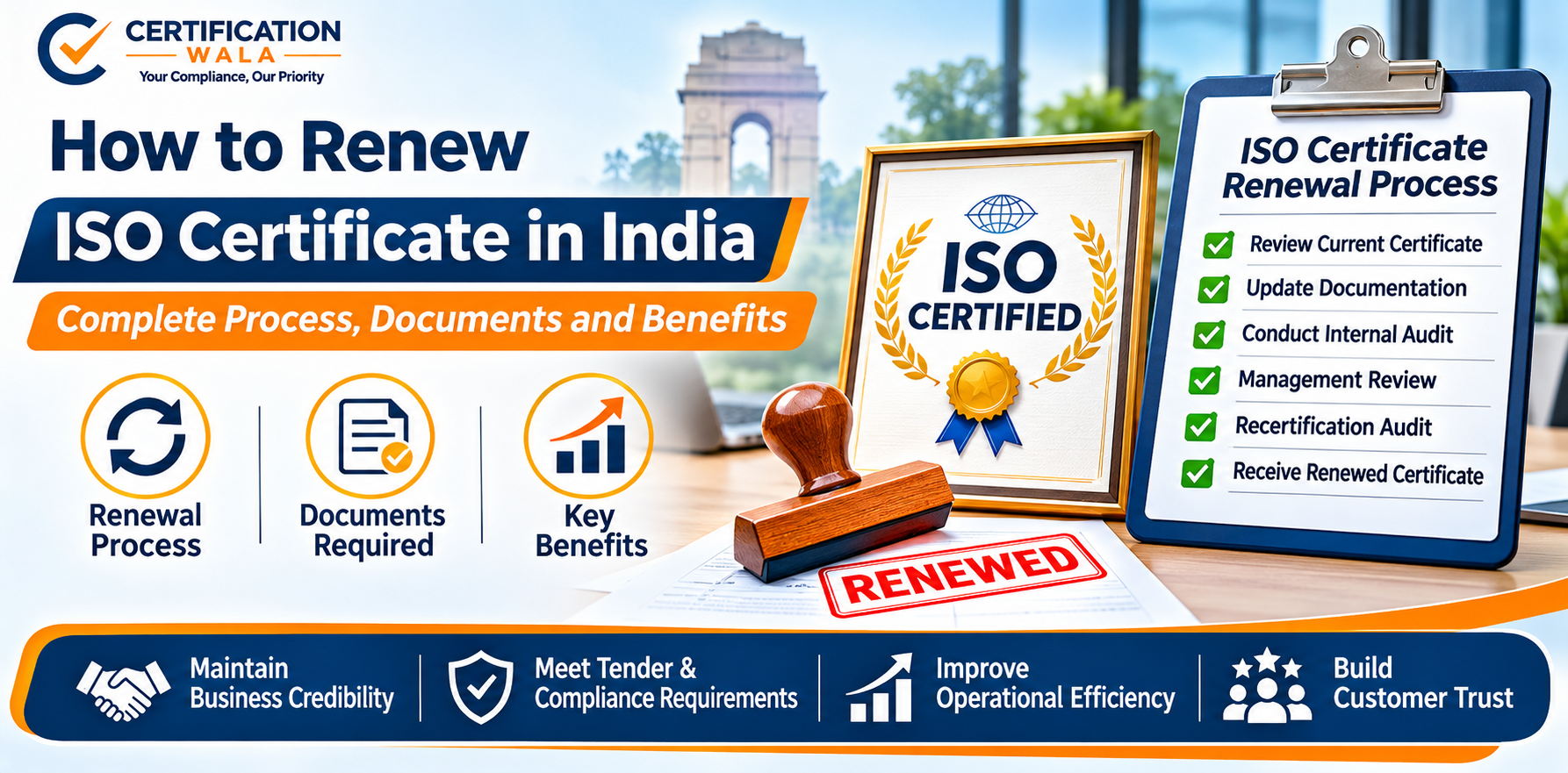
How to Renew ISO Certificate in India Complete Process Documents and Benefits
Introduction
Getting an ISO certificate is an important achievement for any business. It demonstrates that your organisation follows recognised management standards and maintains a structured approach to quality, safety, environmental responsibility or information security.
However, receiving an ISO certificate is not the end of the process. You must maintain your management system, complete periodic audits and renew your certification before it expires.
If you are wondering how to renew an ISO certificate in India, the process involves reviewing your existing management system, checking compliance with the applicable ISO standard, completing the required audit and receiving a renewed certificate from your certification body.
Generally, an ISO management system certificate is valid for three years, subject to successful surveillance audits and continued compliance. The recertification audit is normally conducted before the certificate expires.
For example, an Indian manufacturing company holding ISO 9001 certification must continue monitoring product quality, customer complaints, production processes and corrective actions throughout the certification cycle.
In this guide, we explain the ISO certificate renewal process in India, required documents, benefits and important points businesses should consider before applying.
Why Is ISO Certificate Renewal Important?
ISO certification is not a permanent approval. It confirms that your organisation meets the requirements of a particular standard during a defined certification cycle.
Renewal is important because it helps your organisation:
-
Maintain its certified status and customer confidence.
-
Demonstrate continued compliance with ISO requirements.
-
Meet vendor registration and tender requirements.
-
Improve internal processes and operational performance.
-
Identify gaps through regular audits.
-
Maintain business opportunities with domestic and international clients.
An expired ISO certificate may create difficulties when participating in government tenders, supplying products to large companies or meeting customer qualification requirements.
Therefore, businesses should begin preparing for renewal several months before the expiry date.
Why Choose Certification Wala for ISO Certificate Renewal?
Choosing the right certification support partner can make the renewal process easier and more organised.
At Certification Wala, we help businesses understand ISO requirements and prepare for the certification and recertification process.
Our approach focuses on practical guidance rather than unnecessary documentation.
Why businesses choose us:
-
Professional Guidance: Assistance in understanding the applicable ISO standard and its requirements.
-
Documentation Support: Guidance on reviewing and updating essential management system documents.
-
Audit Preparation: Help preparing for internal audits and external certification audits.
-
Multiple ISO Standards: Support for standards such as ISO 9001, ISO 14001, ISO 45001 and ISO 27001.
-
Business-Focused Approach: Solutions suitable for startups, MSMEs, manufacturers, service providers and established organisations.
-
Transparent Assistance: Clear guidance about the process, requirements and applicable certification arrangements.
Our objective is to help your business maintain its management system and approach the renewal audit with confidence.
Key Benefits of Renewing Your ISO Certificate
Renewing your ISO certification is not just about keeping a certificate active. It gives your organisation an opportunity to evaluate performance and improve its management system.
1. Maintains Business Credibility
An active ISO certificate demonstrates your commitment to maintaining recognised management practices. It helps build confidence among customers, suppliers and business partners.
2. Supports Government and Private Tenders
Many government departments, large companies and procurement teams specify ISO certification in their tender or vendor eligibility requirements. Maintaining valid certification can help your organisation meet these conditions.
3. Improves Operational Efficiency
The renewal process encourages businesses to review their existing procedures, identify unnecessary activities and improve operational performance.
4. Strengthens Customer Satisfaction
By reviewing complaints, feedback and service performance, businesses can identify recurring problems and take corrective action.
5. Encourages Continuous Improvement
Regular audits help organisations identify weaknesses and implement practical improvements instead of following outdated procedures.
6. Supports International Business Opportunities
Businesses involved in exports and international supply chains may benefit from maintaining an appropriate ISO-certified management system when customers require it.
Step-by-Step ISO Certificate Renewal Process in India
If your existing ISO certificate is approaching its expiry date, follow these steps to complete the ISO renewal process smoothly.
Step 1: Check Your Existing ISO Certificate
First, review your current certificate and verify:
-
ISO standard and applicable edition.
-
Certificate number and issuing certification body.
-
Original certification and expiry dates.
-
Certified company name and business address.
-
Approved scope of certification.
-
Previous surveillance audit details.
For example, if your company holds ISO 9001 certification, check whether the certificate covers all the business activities you currently perform.
Step 2: Contact Your Certification Body
Contact your existing certification body before the certificate expires. Request information about the recertification audit, applicable fees, required documents and available audit dates.
If you want to change your certification body, discuss the transfer requirements. Transfers are subject to applicable certification and accreditation rules.
Step 3: Review and Update Your Documentation
Check whether your management system documents are still relevant to your current business operations.
Update documents wherever necessary, including:
-
Quality or applicable management system policy.
-
Management system objectives.
-
Standard operating procedures (SOPs).
-
Risk assessments and process records.
-
Employee training records.
-
Customer feedback and complaint records.
-
Corrective action reports.
For example, if a manufacturing company has introduced new machinery, its production and inspection procedures may need updating.
Step 4: Conduct an Internal Audit
An internal audit helps determine whether your organisation continues to meet the applicable ISO requirements.
During this review, examine:
-
Implementation of documented procedures.
-
Employee awareness and responsibilities.
-
Process performance and operational controls.
-
Previous audit observations.
-
Customer complaints and corrective actions.
-
Compliance with applicable requirements.
Any identified nonconformities should be investigated and addressed.
Step 5: Complete the Management Review
Top management should review the effectiveness of the management system.
The review may cover audit results, customer satisfaction, performance against objectives, resource requirements, risks, changes affecting the organisation and improvement opportunities.
This step helps management understand whether the existing system is delivering the expected results.
Step 6: Attend the Recertification Audit
The certification body conducts a recertification audit to assess whether your management system continues to fulfil the applicable standard's requirements.
Unlike a routine surveillance audit, the recertification audit evaluates the overall effectiveness of the system across the certification cycle.
The auditor may examine records, interview employees, inspect operational activities and review the effectiveness of previous corrective actions.
Step 7: Close Nonconformities and Receive the Renewed Certificate
If the auditor identifies nonconformities, your organisation must take appropriate corrective action and provide the required evidence within the agreed timeframe.
After satisfactory audit completion, review and certification decision, the certification body can renew the certificate for the next certification cycle.
Important: Complete the required audit, corrective actions and certification decision before the current certificate expires to avoid a gap in certification.
stqc.gov.in+2
Documents Required for ISO Certificate Renewal in India
The documents required for ISO certificate renewal depend on the applicable standard, organisation size, business activities and certification body's requirements.
Generally, businesses should keep the following documents ready:
|
Document |
Purpose |
|---|---|
|
Existing ISO certificate |
Verifies current certification details |
|
Company registration proof |
Confirms legal business identity |
|
PAN card |
Business identification |
|
GST certificate, if applicable |
Tax registration details |
|
Updated company information |
Confirms address and operational changes |
|
Management system policy |
Demonstrates management commitment |
|
Quality or relevant objectives |
Shows measurable organisational targets |
|
Internal audit report |
Provides evidence of internal evaluation |
|
Management review records |
Shows management-level assessment |
|
Corrective action reports |
Demonstrates resolution of audit findings |
|
Employee training records |
Shows employee competence and awareness |
|
Operational records |
Demonstrates implementation of procedures |
|
Customer feedback records |
Helps evaluate customer satisfaction |
Important: Not every organisation needs every document listed above. The exact documentation depends on the applicable ISO standard and the scope of certification.
How Much Does ISO Certificate Renewal Cost in India?
The ISO certificate renewal cost in India is not fixed. It depends on several factors, including:
-
Type of ISO certification.
-
Number of employees.
-
Number of business locations.
-
Complexity of business operations.
-
Scope of certification.
-
Existing documentation and management system.
-
Audit duration and certification body fees.
-
Consultancy or additional preparation support, if required.
For an accurate quotation, businesses should share their existing certificate and company details with the certification provider.
Do not compare renewal quotations on price alone. Always verify the certification body's accreditation, scope and audit arrangements before proceeding.
When Should You Apply for ISO Certificate Renewal?
Ideally, start preparing three to six months before your certificate's expiry date. This gives your organisation sufficient time to review documentation, address audit findings and schedule the recertification audit.
Avoid waiting until the last few days. Audit scheduling, corrective actions and certification decisions can take additional time.
If your certificate has already expired, contact your certification body immediately. Depending on the applicable rules and circumstances, restoration or a fresh certification process may be necessary. Do not claim certified status during a period when certification is not valid.
Frequently Asked Questions About ISO Certificate Renewal
1. How often should an ISO certificate be renewed in India?
Most management system certifications follow a three-year certification cycle. During this period, organisations generally undergo surveillance audits, followed by a recertification audit before the certification cycle ends.
2. Can I renew my ISO certificate after its expiry date?
An expired ISO certificate cannot simply be treated as active. Depending on the applicable certification rules and time since expiry, the certification body may consider restoration or require a fresh certification process. Contact your certification body immediately.
3. What documents are required for ISO certificate renewal?
Common documents include your existing ISO certificate, company registration details, management system policies, internal audit reports, management review records, employee training records and corrective action reports. Additional documents may be required depending on the ISO standard.
4. How much does ISO certificate renewal cost in India?
The cost depends on the ISO standard, company size, number of employees, business locations, certification scope and audit requirements. Contact a certification provider for a quotation based on your business requirements.
5. Is an audit compulsory for ISO certificate renewal?
Yes. A recertification audit is generally required to evaluate whether the organisation's management system continues to meet the applicable ISO standard. The certification body must complete the required assessment before making its renewal decision.
Conclusion: Renew Your ISO Certificate Without Delays
ISO certification is an ongoing commitment to quality, safety, efficiency and customer satisfaction. Renewing your certificate at the right time helps your business maintain its certified status, strengthen customer confidence and continue meeting relevant business requirements.
Understanding how to renew an ISO certificate in India makes it easier to prepare documents, complete internal audits, address nonconformities and coordinate with the certification body.
Whether you hold ISO 9001, ISO 14001, ISO 45001, ISO 27001 or another management system certification, proper preparation can make the recertification process more organised.
Looking for professional assistance with ISO certificate renewal in India?
Certification Wala can guide your business through documentation preparation, renewal requirements and audit coordination.
Contact our team today for expert guidance and a customised quotation.
-
Email: info@certificationwala.com
-
Website: https://certificationwala.com/
-
Contact: +91 97119 97756
Renew your ISO certification on time and keep your business moving forward with confidence.