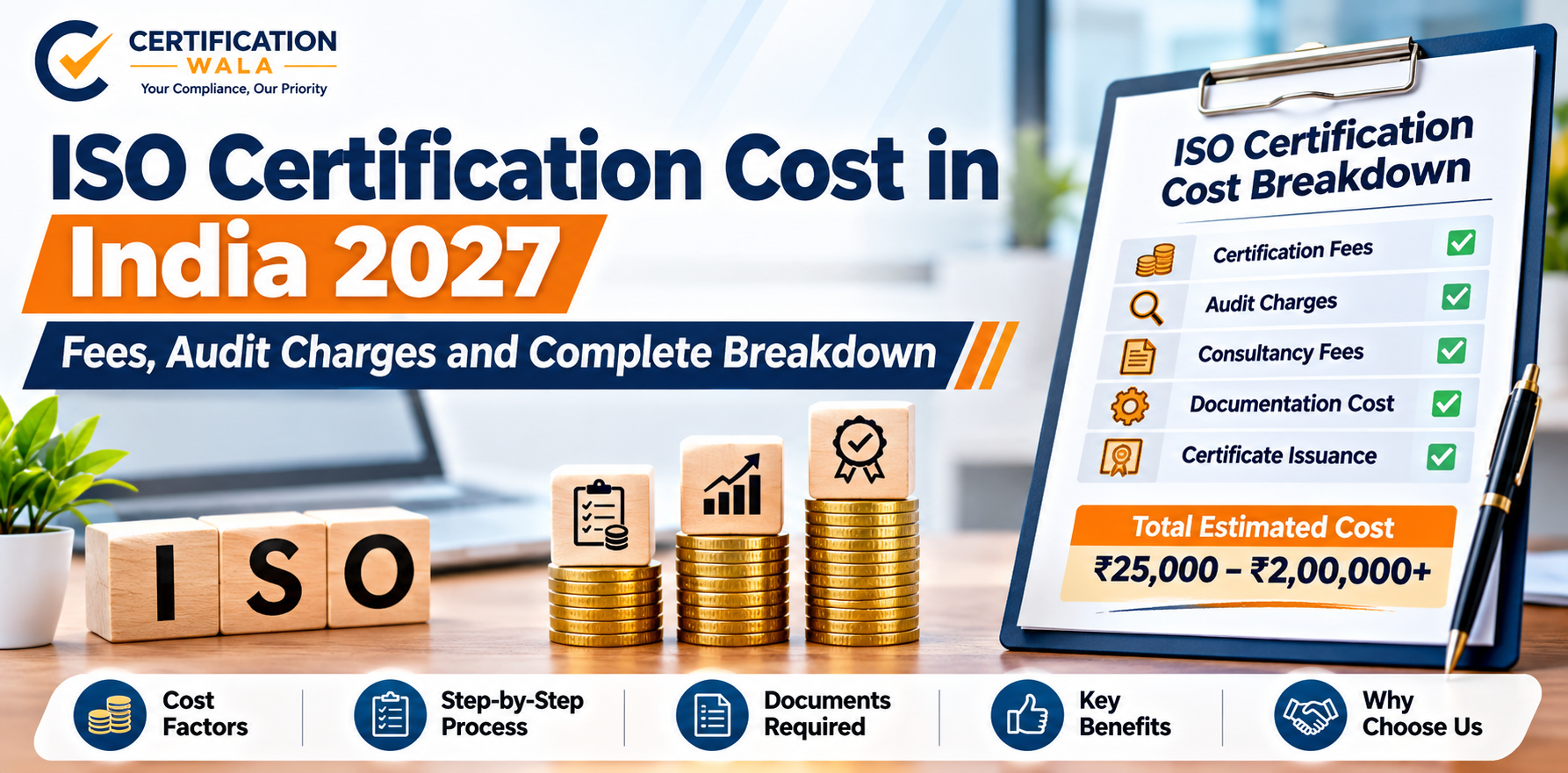
ISO Certification Cost in India 2027 Fees Audit Charges and Complete Breakdown
Introduction
ISO certification has become an important requirement for Indian businesses looking to improve operational quality, build customer confidence and participate in government tenders or international business opportunities.
However, one common question business owners ask before starting is: How much does ISO certification cost in India in 2027?
The answer depends on several factors, including the ISO standard, number of employees, business activities, locations and audit requirements.
For a small business, the estimated ISO certification cost may start from approximately ₹25,000, while specialised certifications and larger organisations may require several lakhs.
Understanding the complete fee structure helps businesses select the right certification without paying for unnecessary services.
In this guide, we explain ISO certification fees in India, audit charges, documentation expenses, required documents and the step-by-step certification process.
ISO Certification Cost in India 2027: Standard-Wise Fees
The estimated ISO certification cost varies according to the management system a business wants to implement.
Below is an indicative market-based price guide for Indian businesses in 2027.
| ISO Standard | Purpose | Estimated Cost |
|---|---|---|
| ISO 9001 | Quality Management | ₹25,000–₹80,000 |
| ISO 14001 | Environmental Management | ₹30,000–₹90,000 |
| ISO 45001 | Occupational Health & Safety | ₹30,000–₹90,000 |
| ISO 22000 | Food Safety Management | ₹35,000–₹1,00,000 |
| ISO 27001 | Information Security | ₹60,000–₹1,50,000 |
| ISO 13485 | Medical Devices Quality | ₹80,000–₹2,00,000 |
Note: These are indicative budgeting ranges, not fixed certification fees or guaranteed quotations. The actual cost may be lower or higher depending on the organisation's size, scope, complexity, audit duration and service requirements. Confirm whether consultancy and certification body charges are included in the quotation.
What Is Included in ISO Certification Fees?
The overall ISO registration cost generally consists of the following expenses:
-
Documentation Charges: Preparing policies, procedures, manuals and other required records.
-
Consultancy Fees: Professional assistance with implementation and compliance.
-
Audit Charges: Stage 1 and Stage 2 certification audits conducted by the certification body.
-
Certificate Issuance: Administrative and certification-related charges.
-
Surveillance Audits: Periodic audits to maintain certification.
-
Additional Expenses: Auditor travel, laboratory testing or other industry-specific requirements, where applicable.
Businesses should always request a written quotation showing each component separately.
Factors That Affect ISO Certification Cost in India
There is no single price applicable to every organisation. The following factors influence the final ISO certification fees.
1. Number of Employees: A company with 10 employees generally requires less audit time than a manufacturing organisation with 150 employees.
2. Business Activities: Manufacturing, construction, food processing and healthcare may require more detailed assessments than straightforward service businesses.
3. Selected ISO Standard: ISO 9001 generally has different implementation requirements from ISO 27001 or ISO 13485.
4. Number of Business Locations: Organisations operating multiple branches or factories may require additional audit arrangements.
5. Existing Documentation: Businesses with established quality management systems may need less preparation than organisations starting from scratch.
6. Certification Body: Accreditation, auditor competence, scope and service arrangements influence the certification charges.
Why Choose Certification Wala?
Selecting the right certification partner is as important as choosing the correct ISO standard.
Certification Wala helps businesses understand applicable ISO requirements and navigate the certification process with professional guidance.
Our support includes:
-
Guidance on selecting the appropriate ISO standard.
-
Assistance with certification documentation.
-
Understanding audit requirements and compliance.
-
Transparent quotation based on business requirements.
-
Support throughout the certification journey.
-
Guidance for surveillance audits and certification maintenance.
Whether you operate a startup, manufacturing unit, trading company, educational institution or service organisation, our team can help you identify a suitable certification route.
Key Benefits of ISO Certification for Indian Businesses
ISO certification is not simply a document for display. It helps organisations establish structured management systems.
Important benefits include:
-
Improved Business Credibility: Demonstrates commitment to recognised management standards.
-
Government Tender Opportunities: Helps meet ISO-related eligibility requirements where specified in tender conditions.
-
Better Customer Confidence: Builds trust among customers, suppliers and business partners.
-
Improved Operational Efficiency: Encourages consistent procedures and process monitoring.
-
International Business Opportunities: Supports supplier qualification and business relationships in global markets.
-
Risk Management: Helps organisations identify and manage operational risks.
-
Competitive Advantage: Strengthens your business profile when competing for contracts.
Step-by-Step ISO Certification Process in India
The ISO certification process generally involves the following stages:
Step 1: Select the Right ISO Standard
Identify your business requirements. For example, manufacturers may consider ISO 9001, food businesses ISO 22000 and IT companies ISO 27001.
Step 2: Submit Business Details
Share your company registration details, employee strength, business activities and operating locations.
Step 3: Gap Analysis and Documentation
Review existing business processes and prepare the required management system documentation.
Step 4: Implement the Management System
Introduce applicable procedures, assign responsibilities and provide employee awareness training.
Step 5: Internal Audit
Conduct an internal assessment to identify gaps and ensure the system is functioning effectively.
Step 6: External Certification Audit
The independent certification body conducts the required audit, generally involving Stage 1 and Stage 2 assessments.
Step 7: Certification Decision and Issuance
After satisfactory audit results and closure of applicable nonconformities, the certification body makes its certification decision and issues the certificate.
Documents Required for ISO Certification
The documents required depend on the selected ISO standard and the nature of the organisation.
Commonly requested documents include:
-
Company registration certificate or incorporation documents.
-
GST registration certificate, where applicable.
-
PAN details of the organisation.
-
Business address proof.
-
Organisation structure and employee details.
-
Description of business activities and processes.
-
Quality policy and objectives, where applicable.
-
Standard operating procedures and work instructions.
-
Employee training and competency records.
-
Internal audit and management review records, where applicable.
-
Risk assessment and compliance-related records.
Not every document must already exist when you first enquire. Some management system documents are developed during implementation.
Frequently Asked Questions (FAQs)
1. What is the ISO certification cost in India in 2027?
The estimated cost generally starts from around ₹25,000 for certain small-business certification requirements. Specialised standards, complex operations and larger organisations may cost ₹1 lakh or more.
2. Which ISO certification is cheapest in India?
ISO 9001 is often among the more affordable management system certifications for small businesses. The final price depends on the certification scope, employee strength and audit requirements.
3. How long does it take to get ISO certification?
The timeline depends on documentation readiness, implementation, audit scheduling and corrective actions. A straightforward small-business project may take a few weeks, while complex organisations may require longer.
4. Is ISO certification mandatory for every business in India?
No. ISO certification is generally voluntary. However, specific customers, contracts, tenders or industry requirements may make a particular certification necessary.
5. Is ISO certification valid for three years?
Management system certificates are commonly issued for a three-year certification cycle, subject to successful surveillance audits and continued compliance. The certification body determines the applicable audit schedule and conditions.
Conclusion: Get an Affordable ISO Certification Quote in India
Understanding the ISO certification cost in India 2027 helps businesses plan their certification budget and choose the right management standard.
Whether you need ISO 9001, ISO 14001, ISO 45001, ISO 22000 or ISO 27001, selecting the appropriate certification route is essential for achieving genuine business value.
At Certification Wala, we help organisations understand certification requirements, documentation, audit procedures and associated costs.
Planning to get ISO certified in 2027?
Contact our team today for a consultation and a quotation based on your business requirements.
Certification Wala
Website: https://certificationwala.com/
Email: info@certificationwala.com
Get professional guidance and take the next step towards building a more credible and quality-focused business.